
Industrial Property Market: 2017 Mid-Year Review
Vistamarc Viewpoint Focus
Industrial Property Market: 2017 Mid-Year Review
August 24, 2017
The Industrial property market continues to be dominated by the performance of distribution warehouses for trade and e-commerce. Although light manufacturing and flex / research and development (R&D) properties have fared well in some markets, supply has not been able to keep up with demand for logistics and distribution properties in primary industrial markets. The evolution of supply chain management for e-commerce has created the need for both large, regional fulfillment centers and urban in-fill warehouses to accommodate “last-mile” delivery. These facilities are essential parts of a distribution network that provides e-tailers and multichannel retailers the ability to create virtual showrooms, reduce on-site inventories and offer timely customer delivery.
The industrial property sector has been one of the strongest performers based on total return, rent growth and vacancy over the past few years. Industrial properties in the NCREIF Property Index (NPI) generated an annualized total return of 12.4% in 2Q 2017 and have returned over 12.0% on an annual basis since 2014. Within CBRE industrial markets, net asking rents increased 6.6% year-over-year and closed the second quarter at a national average $6.78 PSF. Over the past five years, average net asking rents in CBRE’s top primary and secondary warehouse markets have grown by 30.1% and 13.2%, respectively. Driving this rent growth, vacancy and availability rates have posted significant declines to new record lows. CBRE industrial markets recently closed the quarter at 4.6% vacancy and 7.8% availability (includes occupied space available for lease).
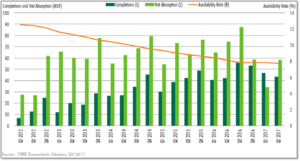
In terms of supply and user demand, CBRE indicates aggregate net absorption has exceeded new construction completions in 20 of the past 21 quarters. After falling to just under 35 million Sq Ft in 1Q 2017, net absorption rebounded sharply to 58.3 million Sq Ft in the second quarter. Reis confirmed this imbalance reporting that net absorption exceeded new supply by a 3:2 ratio for warehouse properties and by an 8:1 ratio for flex / R&D properties in the second quarter. Leasing momentum is expected to continue based on trade activity and shipping efficiencies experienced by retailers and fulfillment suppliers in local markets. CBRE estimates that a development pipeline of 221 million Sq Ft currently exists to support user demand. However, construction activity is expected to decline after 2017 due to land constraints, rising construction costs and stricter lending policies. Assuming continued economic growth, a tight supply environment bodes well for further rental rate growth and vacancy rate compression.
Robust transaction activity in the second quarter pushed industrial sales to just over $29 million in the first half of 2017, an 8.1% increase over the first half of 2016 according to RCA data. The industrial component of the RCA CPPI (repeat property sales index) confirms investor demand in terms of price growth. As of June 2017, the industrial component of the index grew 8.1% year-over-year and has grown at a compound annual growth rate of 9.9% since of June 2012.
Cap rates for industrial properties have dropped across the nation to levels matching averages seen in 2016 and 2007. In May, RCA indicated that the nationwide average cap rate for industrial properties was 6.8%. In some markets such as Seattle, Inland Empire, Northern New Jersey and Miami, cap rates for stabilized industrial properties have fallen to a range of 3.75% – 4.50% according to both RCA and CBRE.
Investment demand for warehouse and distribution properties will continue on the strength of property fundamentals and demand drivers for trade and ecommerce. With bipartisan support, the President’s $1 trillion infrastructure plan should also provide a substantial boost to logistics services. Industrial returns will moderate as primary and secondary market acquisition and development opportunities become more limited. Large, portfolio transactions are expected in the second half of 2017 from both domestic and foreign institutional buyers. Portfolio transactions will naturally drive down yields, but NCREIF expects the sector to continue to post above average returns over the near term.
Investors typically view distribution centers as low-maintenance, low-volatility income generators supported by triple net lease structures. Institutional investors target distribution centers as long term holds. The relatively low construction cost, short development time frame (6-12 months) and steady demand makes this an ideal property type for develop-to-core investors. In some cases, investors can pay up to 25% less through a development partnership rather than buying a fully leased industrial facility. Select urban in-fill, markets will continue present new development and redevelopment opportunities for investors.
Key industrial property investment risks in this environment include the following:
• Pricing relative to the maturity of the current investment cycle. Class A logistics and big-box distribution opportunities have been difficult to find in primary industrial markets. Paying top dollar in primary and secondary markets may have lasting income and valuation impacts in the event of cyclical market changes.
• Supply versus net absorption reversal. To date, net absorption has exceeded supply across the country, but the spread has narrowed recently. Multiple estimates indicate a development pipeline of 220 – 260 million Sq Ft exists. Land is constrained in core markets, but developers have found opportunities in secondary and tertiary markets.
• Tertiary market and specialized use. Investments in non-core markets can be more susceptible to cyclical changes in user demand, new supply and economic growth. Specialized warehouse uses such as multi-level mezzanine, cold / freezer storage and urban last-mile distribution can present more risk in a downturn.
• Retail industry collateral damage. The effects of retail bankruptcies, store closings and consolidation have only begun. Will deep retailer fallout have a lasting impacts on jobs, supply-chain and distribution requirements? Owners and asset managers of light / multi-tenant warehouse facilities should carefully evaluate the credit quality, retail customer relationships and experience of third party logistics firms and e-commerce suppliers as lessees.
• Protectionist US trade policies. Significant changes to U.S. trade policies in the form of steep tariffs and taxes to key trading partners can negatively impact future economic growth and industrial demand. To date, no specific policy changes have been proposed. It is likely that specific modifications will be far different than the President’s nationalistic rhetoric.
Marco Gonzalez
Managing Partner, Senior Asset Manager
Vistamarc Realty Advisors LLC